

Prompt template
NIKO Giant Panda Bamboo Comedy (Character Sheet → Seedance 2.5 Workflow)
A two-step workflow: create a full character-design sheet for an original giant panda, then hand it to Seedance 2.5 for a 30-second 3D animated comedy short starring NIKO — shared by @HeyAbhishek.
Demo video
View caseWorkflow
Run these 2 steps in order. Copy each prompt, generate, then use the result as the next step's reference.
- 1
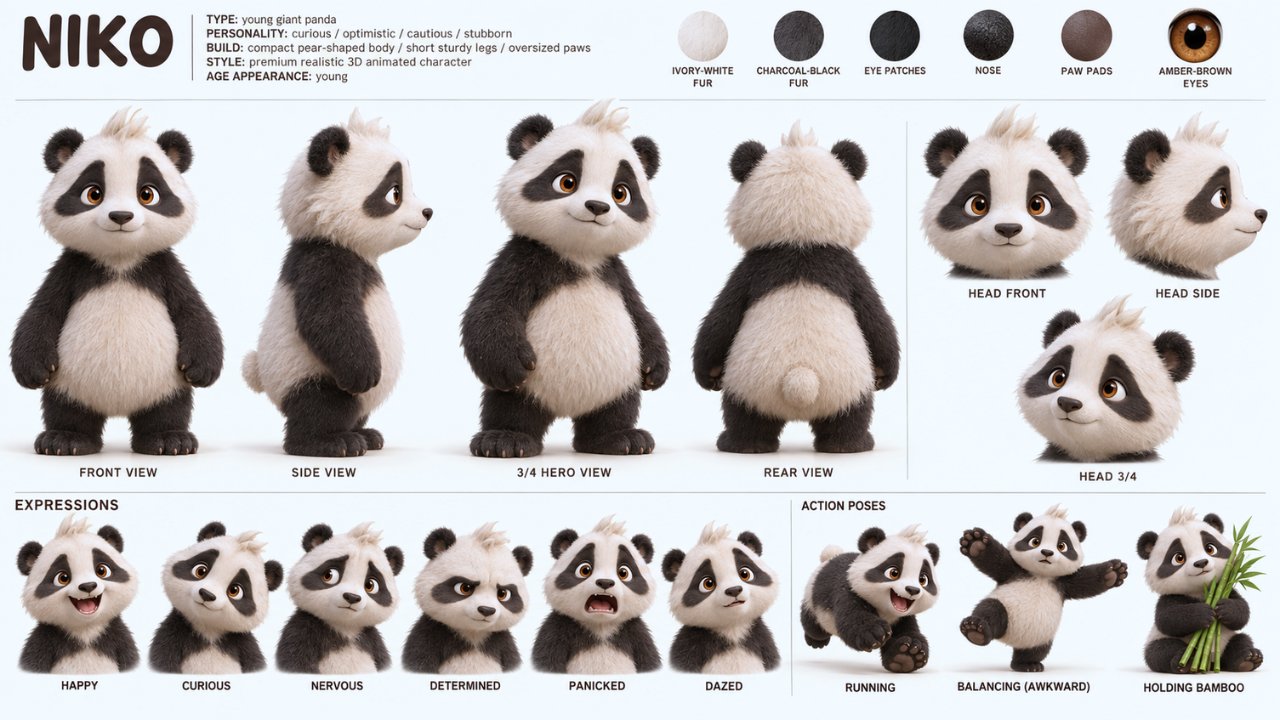
NIKO character sheet
ImageCreate a premium character-design reference sheet on a clean light cream / pale warm-yellow studio background for an entirely original young giant panda named NIKO. Organize the image like a professional high-end 3D animated feature-film character model sheet. Every view must show the exact same Niko with strict identity, fur markings, facial structure, body proportions and paw consistency. At the top-left, include the simple title “NIKO”. Under the title, include small character information reading: TYPE: young giant panda, PERSONALITY: curious / optimistic / cautious / stubborn, BUILD: compact pear-shaped body / short sturdy legs / oversized paws, STYLE: premium realistic 3D animated character, AGE APPEARANCE: young. Include a small labeled color palette for IVORY-WHITE FUR, CHARCOAL-BLACK FUR, EYE PATCHES, NOSE, PAW PADS and AMBER-BROWN EYES. Show a large full-body front view and full-body side view on the left. In the center, show a large full-body 3/4 hero view and a full-body rear view. On the right, show head front, head side and head 3/4 views. Along the bottom, include an expression strip showing HAPPY, CURIOUS, NERVOUS, DETERMINED, PANICKED and DAZED expressions. Beside the expression strip, include three small action poses showing Niko running with his short legs moving rapidly, balancing awkwardly with all four paws spread outward, and holding several leafy bamboo stems proudly against his chest. Niko is a completely original young giant panda with a compact slightly pear-shaped body, short sturdy legs, broad oversized paws and a large rounded head. His main fur is warm ivory-white rather than pure white. His ears, shoulders, upper arms, legs and eye markings are deep soft charcoal-black. His eye patches are slightly tapered toward the outside rather than perfectly circular. He has large warm amber-brown eyes with visible brown irises and natural highlights, a small glossy black nose, soft rounded cheeks and a small asymmetrical tuft of ivory fur on top of his head that leans slightly to one side. His paws are broad and soft with subtle dark paw pads. His limbs are short but physically capable of supporting his body. His proportions should feel cute and expressive while preserving believable panda anatomy. His facial expressions should come naturally from his eyes, eyelids, ears, mouth, head angle and body posture rather than extreme facial deformation. Niko has one small natural panda tail permanently attached behind his body. The tail remains identical in every view. Never enlarge it into a long tail, never duplicate it and never detach it. No clothing, no hat, no scarf, no shoes, no backpack, no accessories, no logos and no weapons. Use premium realistic 3D CGI animated-film rendering with detailed soft fur, realistic fur breakup around the cheeks and body edges, physically believable materials, natural eye reflections, subtle contact shadows and clean cinematic studio lighting. Combine believable giant panda anatomy with slightly exaggerated proportions suitable for expressive physical comedy. Niko must have a completely original visual identity. Do not reproduce or closely resemble any recognizable existing animated panda, mascot, film character or franchise character. Use only the clean light cream / pale warm-yellow studio background. No environment, no snow, no unrelated objects and no additional characters. Every model-sheet view must preserve the exact same face, amber-brown eyes, eye-patch shapes, fur distribution, head tuft, body proportions, paws and small natural tail.
This step's result
- 2
Seedance 2.5 video
VideoCreate an exactly 30-second vertical 16:9 premium 3D animated comedy short. Use the attached Niko character sheet as the exact visual reference for Niko. Maintain his identical face, amber-brown eyes, charcoal eye patches, ivory-white fur, charcoal-black limbs, small asymmetrical head tuft, compact pear-shaped body, short sturdy legs, oversized paws and small natural panda tail throughout every frame. The reference defines Niko's appearance only. Do not copy poses or environments from the character sheet. If a storyboard board is also provided, use it only as a sequence and composition guide. Each storyboard panel represents a different moment in time, so never combine multiple Niko poses from different panels into the same frame. The entire story takes place around one small completely frozen mountain pond during bright clear winter daylight. The pond is approximately 4.5 meters across and lies between two fixed snowy banks. Bank A is Niko's starting side and final destination. Bank B is the opposite side where the bamboo bundle is located. In all wide lateral shots, Bank A must remain on screen-left and Bank B on screen-right. During the first crossing Niko moves from left to right. During the return crossing he moves from right to left. Never mirror the world, swap the banks, reverse the geography or create a third bank. The frozen pond is flat, horizontal, smooth, solid and completely frozen from one side to the other. The surface is pale blue-gray with subtle reflections and a thin frosted texture near the edges. It must always look like solid ice, never liquid water. There are no cracks, holes, broken sections, splashes, bumps, sudden slopes, invisible currents or melting. Both banks slope gently down toward the ice. Immediately beyond each ice edge is a deep area of loose powdery snow approximately 60 to 80 centimeters deep. These are the soft stopping zones. No rocks, logs, tree trunks, hard branches or other solid obstacles are allowed in either landing path. Dense living bamboo grows farther behind both banks, with light snow resting naturally on some leaves and stems. The living bamboo never enters Niko's sliding path. One loose bamboo bundle begins on Bank B approximately one meter to the side of Niko's first landing zone. It contains exactly four short fresh green bamboo stems tied securely at the center with one simple tan natural-fiber cord. The bundle is compact, approximately the width of Niko's torso, and light enough for him to carry comfortably. It remains one single prop for the entire story. Niko never breaks, cuts or pulls bamboo from a living plant. The core story is simple. Niko notices the bamboo bundle across the frozen pond and wants it. He cautiously tests the ice, tries to cross, loses traction and accidentally slides across on his belly after his final hind paw pushes against the snowy edge. He reaches Bank B and crashes harmlessly into deep powdery snow. His failed crossing accidentally works. He finds the bamboo beside him, picks it up and realizes he must cross the same ice again. This time he deliberately uses his belly as a slide. He hugs the bamboo against his chest, pushes off from the snow with both hind paws and glides confidently toward Bank A. He becomes overconfident and tries steering with one hind paw. That uneven drag creates rotational momentum and slowly turns his body exactly 180 degrees while he continues traveling in the same direction. He is now sliding backward toward Bank A. He reaches the bank rear-first, disappears harmlessly into deep snow, pops up still holding the bamboo and immediately takes a bite as though everything went exactly according to plan. Use a premium realistic 3D CGI animated-film aesthetic with highly detailed soft panda fur, realistic powdery snow, subtle ice reflections, dense natural bamboo, distant snowy mountain peaks, bright crisp winter daylight, soft atmospheric depth, natural shadows and expressive but controlled physical comedy. Keep Niko cute but anatomically believable. Avoid extreme limb stretching, rubbery deformation or exaggerated facial distortion. Every major movement must have a visible physical cause. Maintain believable body weight, gravity, momentum, low friction on smooth ice and strong resistance from deep snow. From 0:00 to 0:02, open immediately with a low wide shot at Bank A. Niko moves quickly through fresh powder snow and stops at the frozen pond edge. Across the pond on Bank B, the single tied bamboo bundle is clearly visible resting on the snow. Niko's eyes widen. Without wasting time, he reaches one front paw onto the ice. The paw immediately slides several centimeters forward. He jerks it back onto the snow, looks down at the ice, then looks back at the bamboo with a determined expression. Keep Bank A on screen-left and Bank B on screen-right. From 0:02 to 0:04, use a medium side shot showing Niko's full body, the frozen pond and the bamboo across the way. Niko cautiously begins stepping onto the ice on all four paws. Both front paws move onto the frozen surface, then one hind paw follows. His final hind paw remains firmly planted in the higher-friction snow at Bank A. Niko lowers his body and attempts one very small forward step. His front paws unexpectedly slide farther forward. His eyes widen and he tries to pull himself backward. From 0:04 to 0:07, use one clear uninterrupted side shot. Niko's front half keeps sliding forward. His body stretches low toward the ice. Trying to recover, his final hind paw instinctively pushes strongly against the snowy edge. Show that push clearly. The snow provides traction and the push sends Niko's body forward. His last hind paw leaves Bank A and Niko gently drops belly-first onto the ice with existing forward momentum. He begins sliding toward Bank B. He remains belly-down and head-first for the entire first crossing. His head stays pointed toward Bank B. His four paws spread outward as he tries to stop himself, but they provide almost no grip. His expression changes from determination to panic. Do not rotate him, spin him, turn him backward or make him accelerate after the initial push. His speed must slowly decrease as he travels across the flat ice. From 0:07 to 0:09, use a wide side shot as Niko approaches Bank B. He is still belly-down and head-first, moving slower than at the beginning of the slide. His front paws enter the deep powder snow first, then his chest. The higher resistance of the snow rapidly slows him and he gently plows head-first into the soft bank with a large fluffy POOF. Powdery snow rises around him and partially buries him. Nothing hard is in his path. The bamboo bundle stays approximately one meter to the side and is not struck or moved. From 0:09 to 0:11, hold on Bank B in a static medium shot. The snow settles. After a brief pause, Niko's head slowly rises from the powder. Snow covers part of his cheeks and head tuft. He blinks, then turns slightly and notices the exact same bamboo bundle beside him. His dazed expression instantly becomes delighted. The bundle has not moved from its established location. From 0:11 to 0:13, Niko climbs completely out of the snow, walks the short distance to the bamboo and picks up the exact same tied bundle using both front paws. One paw grips one side and the other grips the opposite side. He hugs it firmly against his upper chest. The four stems remain tied together. No stems fall out and no leaves detach. Niko smiles proudly. From 0:13 to 0:15.5, use a medium shot as Niko turns toward the frozen pond while still holding the bamboo tightly against his chest. He looks across toward Bank A, then looks down at the ice. His smile disappears as he remembers the first crossing. After a short beat, he looks at his own belly, then at the smooth ice, then back toward Bank A. His eyes brighten. He has an idea. His expression changes into a confident grin. Niko turns so his body points directly toward Bank A and continues holding the bamboo securely against his upper chest. From 0:15.5 to 0:18, use a wide side shot showing the full physical setup. Niko crouches low in the powder snow on Bank B about one body length away from the ice edge. Both front paws continue holding the bamboo bundle against his upper chest. Niko takes two short quick steps through the snow toward the pond. As he reaches the edge, he lowers his body and places his belly onto the start of the ice. At that moment both hind paws remain briefly planted in the snow behind him. Niko pushes strongly backward against the snow with both hind paws. Show this push clearly. The higher-friction snow provides traction and launches him forward into a controlled belly slide toward Bank A. This is not a jump and Niko never becomes airborne. He transitions directly from snow to ice. The bamboo remains held firmly against his upper chest. From 0:18 to 0:21, use a beautiful low lateral tracking shot as Niko glides smoothly from Bank B toward Bank A on his belly. His body remains aligned with the direction of travel and his head points toward Bank A. Both front paws remain wrapped around the bamboo bundle. The bamboo rests against his upper chest and stays slightly above the ice. The bamboo never touches or drags across the ice and never functions as a sled. Niko realizes his deliberate technique is working. His nervous expression becomes surprised, then proud, then extremely happy. He raises his head slightly and smiles broadly as though he has mastered the pond. His sliding speed slowly decreases and he never accelerates. From 0:21 to 0:23.5, continue the same direction of travel toward Bank A. Niko is visibly overconfident. Still hugging the bamboo with both front paws, he deliberately lowers his right hind paw until the paw pad lightly touches the ice. He attempts to use it like a rudder. The right hind paw creates noticeably more friction than the rest of his body. This uneven drag pulls one side of his rear body backward and begins rotating Niko around a vertical axis. His smile immediately starts disappearing. The right hind paw stops dragging after the initial steering attempt. Do not keep applying force after the rotation begins. From 0:23.5 to 0:26, use a wide lateral tracking shot. Niko continues translating toward Bank A because of his existing forward momentum. At the same time, the rotational momentum created by the brief right-paw drag slowly turns his entire body. He completes exactly one 180-degree half-turn over this interval. Not 360 degrees and not multiple spins. The rotation is slow, readable and controlled. Niko remains belly-down. The bamboo bundle remains clutched securely against his upper chest and rotates together with him as one carried object. Never leave the bamboo behind and never duplicate it. At the end of the half-turn, Niko's hindquarters point toward Bank A while his face points back toward Bank B. His direction of travel has not changed. Only his body orientation has changed. His expression shifts from confidence to confusion and then panic. From 0:26 to 0:28, show Niko sliding rear-first toward Bank A. His hind paws and rear body lead the motion while his head faces the opposite direction. He twists his neck and looks over one shoulder toward the approaching Bank A snowbank. His eyes widen. Niko tries to brake by gently pressing both hind paws against the ice, but they provide very little grip. His speed continues gradually decreasing, but he cannot stop before reaching the bank. Do not rotate him again, turn him forward or accelerate him. The bamboo remains securely held against his chest. From 0:28 to 0:30, use one uninterrupted wide side shot showing the entire final cause and effect. Niko reaches Bank A rear-first. His hind paws and lower body enter the deep powder snow first. The snow creates strong resistance and rapidly slows his rear body. He slides backward slightly deeper into the soft powder and becomes half-buried rear-first with a large soft POOF. There is no flip, no head-first collision, no sudden pose change and no hard impact. The snow settles quickly. Niko remains sitting half-buried with his head, shoulders, front paws and the exact same bamboo bundle visible above the surface. He is completely unharmed. He blinks, looks at the bamboo, calmly raises one leafy end toward his mouth and takes one large satisfied bite. His expression becomes completely content. Cut to black. Maintain strict Niko consistency throughout all 30 seconds. Niko always has the same facial structure, amber-brown eyes, charcoal eye patches, ivory-white fur, charcoal-black fur distribution, asymmetrical head tuft, ear shape, body proportions, limb lengths, oversized paws and small natural panda tail. He has exactly one head, two ears, two eyes, two front paws, two hind paws and one small natural tail. Never add or remove limbs. Never create human hands or fingers. Never create a long tail. Never duplicate Niko. Never show multiple simultaneous copies, ghost bodies, motion-trail duplicates or several poses of Niko in one physical frame. Motion blur may appear only as subtle blur on one continuous body. Maintain strict bamboo continuity. There is exactly one carried bamboo bundle containing exactly four tied stems. It begins on Bank B and remains there until Niko picks it up at approximately 0:11. After that moment, both front paws hold the same bundle continuously until the end. The bundle never duplicates, disappears, teleports, changes size, changes color, changes stem count, unties itself, breaks apart, transforms, floats independently or flies away. No bamboo leaves detach during the return journey. Niko may bite one leafy end only in the final second. Maintain strict first-crossing physics. The first slide begins only because Niko's final hind paw visibly pushes against the higher-friction snow. The ice itself does not pull him. The wind does not push him. The pond does not slope. Niko remains head-first and belly-down for the entire first crossing with zero rotation. Maintain strict second-crossing physics. The return slide begins only because both hind paws visibly push against the snow on Bank B. Niko never jumps and never becomes airborne. After entering the flat ice, he gradually loses speed. At approximately 0:21, Niko briefly drags only his right hind paw. That brief asymmetric friction creates rotational momentum. The paw then stops dragging. Niko completes exactly one 180-degree half-turn because of that existing rotational momentum. His direction of travel continues toward Bank A throughout. Rotation changes only his orientation and never reverses his travel direction. The ice remains physically identical throughout the entire video. It stays flat, horizontal, solid, smooth, unbroken and completely frozen. No cracks, holes, liquid water, splashes, sinking, melting, bumps, slopes or invisible currents. The geography never changes. There is one pond and exactly two banks. Bank A is the starting side and final destination. Bank B contains the bamboo bundle. In lateral shots Bank A stays on screen-left and Bank B stays on screen-right. Never mirror the environment, change the pond width, relocate the bamboo or teleport Niko between banks. The final landing must remain rear-first. Niko's hindquarters reach the deep snow first and he stays oriented backward throughout the impact. The snow stops him. He does not flip, rotate again, become head-first or collide with anything hard. He finishes half-buried in soft snow while still holding the bamboo. Prioritize clear physical readability over flashy camera movement. Use side views whenever sliding direction, geography or cause and effect need to be understood. Keep the established left-right screen axis consistent. Do not orbit the camera around Niko during the 180-degree turn. The camera must remain relatively stable so the audience can clearly see that Niko's body is rotating. Do not use camera rotation to fake spinning. Avoid rapid cuts during the first hind-paw push, the deliberate second push-off, the steering paw touching the ice, the 180-degree rotation and the final rear-first snow entry. Use playful adventurous orchestral music throughout. Include natural crisp winter ambience, soft wind, gentle living bamboo-leaf rustling, soft paw footsteps through powder snow, subtle paw friction when Niko tests the ice, small slipping sounds as his paws lose traction, a clear snow push sound when his hind paw launches the first slide, soft belly contact with the ice, smooth continuous sliding sound, a large soft POOF when he reaches Bank B, a brief comedic pause, warm playful music when he notices the bamboo, soft bamboo rustling when he picks it up, a short determined buildup before the second attempt, a clear double snow push from both hind paws during the deliberate launch, smooth confident gliding sounds, briefly triumphant music while Niko enjoys the successful slide, one small friction sound when the right hind paw touches the ice, a gradual confused musical phrase during the 180-degree half-turn, increased tension as Niko approaches Bank A backward, a large soft final POOF when he enters the snow rear-first, brief silence, soft bamboo rustling and one small satisfied orchestral note when Niko takes the final bite.
Customize this last step in the workbench below, then copy.
Reference images
This step's result
Start from an example
Pick an example to load its exact settings, then make it yours.
Make it yours
Only the parts worth changing are shown. The prompt updates as you go.
Your prompt
Create an exactly 30-second vertical 16:9 premium 3D animated comedy short. Use the attached Niko character sheet as the exact visual reference for Niko. Maintain his identical face, amber-brown eyes, charcoal eye patches, ivory-white fur, charcoal-black limbs, small asymmetrical head tuft, compact pear-shaped body, short sturdy legs, oversized paws and small natural panda tail throughout every frame. The reference defines Niko's appearance only. Do not copy poses or environments from the character sheet. If a storyboard board is also provided, use it only as a sequence and composition guide. Each storyboard panel represents a different moment in time, so never combine multiple Niko poses from different panels into the same frame.
The entire story takes place around one small completely frozen mountain pond during bright clear winter daylight. The pond is approximately 4.5 meters across and lies between two fixed snowy banks. Bank A is Niko's starting side and final destination. Bank B is the opposite side where the bamboo bundle is located. In all wide lateral shots, Bank A must remain on screen-left and Bank B on screen-right. During the first crossing Niko moves from left to right. During the return crossing he moves from right to left. Never mirror the world, swap the banks, reverse the geography or create a third bank.
The frozen pond is flat, horizontal, smooth, solid and completely frozen from one side to the other. The surface is pale blue-gray with subtle reflections and a thin frosted texture near the edges. It must always look like solid ice, never liquid water. There are no cracks, holes, broken sections, splashes, bumps, sudden slopes, invisible currents or melting. Both banks slope gently down toward the ice. Immediately beyond each ice edge is a deep area of loose powdery snow approximately 60 to 80 centimeters deep. These are the soft stopping zones. No rocks, logs, tree trunks, hard branches or other solid obstacles are allowed in either landing path.
Dense living bamboo grows farther behind both banks, with light snow resting naturally on some leaves and stems. The living bamboo never enters Niko's sliding path. One loose bamboo bundle begins on Bank B approximately one meter to the side of Niko's first landing zone. It contains exactly four short fresh green bamboo stems tied securely at the center with one simple tan natural-fiber cord. The bundle is compact, approximately the width of Niko's torso, and light enough for him to carry comfortably. It remains one single prop for the entire story. Niko never breaks, cuts or pulls bamboo from a living plant.
The core story is simple. Niko notices the bamboo bundle across the frozen pond and wants it. He cautiously tests the ice, tries to cross, loses traction and accidentally slides across on his belly after his final hind paw pushes against the snowy edge. He reaches Bank B and crashes harmlessly into deep powdery snow. His failed crossing accidentally works. He finds the bamboo beside him, picks it up and realizes he must cross the same ice again. This time he deliberately uses his belly as a slide. He hugs the bamboo against his chest, pushes off from the snow with both hind paws and glides confidently toward Bank A. He becomes overconfident and tries steering with one hind paw. That uneven drag creates rotational momentum and slowly turns his body exactly 180 degrees while he continues traveling in the same direction. He is now sliding backward toward Bank A. He reaches the bank rear-first, disappears harmlessly into deep snow, pops up still holding the bamboo and immediately takes a bite as though everything went exactly according to plan.
Use a premium realistic 3D CGI animated-film aesthetic with highly detailed soft panda fur, realistic powdery snow, subtle ice reflections, dense natural bamboo, distant snowy mountain peaks, bright crisp winter daylight, soft atmospheric depth, natural shadows and expressive but controlled physical comedy. Keep Niko cute but anatomically believable. Avoid extreme limb stretching, rubbery deformation or exaggerated facial distortion. Every major movement must have a visible physical cause. Maintain believable body weight, gravity, momentum, low friction on smooth ice and strong resistance from deep snow.
From 0:00 to 0:02, open immediately with a low wide shot at Bank A. Niko moves quickly through fresh powder snow and stops at the frozen pond edge. Across the pond on Bank B, the single tied bamboo bundle is clearly visible resting on the snow. Niko's eyes widen. Without wasting time, he reaches one front paw onto the ice. The paw immediately slides several centimeters forward. He jerks it back onto the snow, looks down at the ice, then looks back at the bamboo with a determined expression. Keep Bank A on screen-left and Bank B on screen-right.
From 0:02 to 0:04, use a medium side shot showing Niko's full body, the frozen pond and the bamboo across the way. Niko cautiously begins stepping onto the ice on all four paws. Both front paws move onto the frozen surface, then one hind paw follows. His final hind paw remains firmly planted in the higher-friction snow at Bank A. Niko lowers his body and attempts one very small forward step. His front paws unexpectedly slide farther forward. His eyes widen and he tries to pull himself backward.
From 0:04 to 0:07, use one clear uninterrupted side shot. Niko's front half keeps sliding forward. His body stretches low toward the ice. Trying to recover, his final hind paw instinctively pushes strongly against the snowy edge. Show that push clearly. The snow provides traction and the push sends Niko's body forward. His last hind paw leaves Bank A and Niko gently drops belly-first onto the ice with existing forward momentum. He begins sliding toward Bank B. He remains belly-down and head-first for the entire first crossing. His head stays pointed toward Bank B. His four paws spread outward as he tries to stop himself, but they provide almost no grip. His expression changes from determination to panic. Do not rotate him, spin him, turn him backward or make him accelerate after the initial push. His speed must slowly decrease as he travels across the flat ice.
From 0:07 to 0:09, use a wide side shot as Niko approaches Bank B. He is still belly-down and head-first, moving slower than at the beginning of the slide. His front paws enter the deep powder snow first, then his chest. The higher resistance of the snow rapidly slows him and he gently plows head-first into the soft bank with a large fluffy POOF. Powdery snow rises around him and partially buries him. Nothing hard is in his path. The bamboo bundle stays approximately one meter to the side and is not struck or moved.
From 0:09 to 0:11, hold on Bank B in a static medium shot. The snow settles. After a brief pause, Niko's head slowly rises from the powder. Snow covers part of his cheeks and head tuft. He blinks, then turns slightly and notices the exact same bamboo bundle beside him. His dazed expression instantly becomes delighted. The bundle has not moved from its established location.
From 0:11 to 0:13, Niko climbs completely out of the snow, walks the short distance to the bamboo and picks up the exact same tied bundle using both front paws. One paw grips one side and the other grips the opposite side. He hugs it firmly against his upper chest. The four stems remain tied together. No stems fall out and no leaves detach. Niko smiles proudly.
From 0:13 to 0:15.5, use a medium shot as Niko turns toward the frozen pond while still holding the bamboo tightly against his chest. He looks across toward Bank A, then looks down at the ice. His smile disappears as he remembers the first crossing. After a short beat, he looks at his own belly, then at the smooth ice, then back toward Bank A. His eyes brighten. He has an idea. His expression changes into a confident grin. Niko turns so his body points directly toward Bank A and continues holding the bamboo securely against his upper chest.
From 0:15.5 to 0:18, use a wide side shot showing the full physical setup. Niko crouches low in the powder snow on Bank B about one body length away from the ice edge. Both front paws continue holding the bamboo bundle against his upper chest. Niko takes two short quick steps through the snow toward the pond. As he reaches the edge, he lowers his body and places his belly onto the start of the ice. At that moment both hind paws remain briefly planted in the snow behind him. Niko pushes strongly backward against the snow with both hind paws. Show this push clearly. The higher-friction snow provides traction and launches him forward into a controlled belly slide toward Bank A. This is not a jump and Niko never becomes airborne. He transitions directly from snow to ice. The bamboo remains held firmly against his upper chest.
From 0:18 to 0:21, use a beautiful low lateral tracking shot as Niko glides smoothly from Bank B toward Bank A on his belly. His body remains aligned with the direction of travel and his head points toward Bank A. Both front paws remain wrapped around the bamboo bundle. The bamboo rests against his upper chest and stays slightly above the ice. The bamboo never touches or drags across the ice and never functions as a sled. Niko realizes his deliberate technique is working. His nervous expression becomes surprised, then proud, then extremely happy. He raises his head slightly and smiles broadly as though he has mastered the pond. His sliding speed slowly decreases and he never accelerates.
From 0:21 to 0:23.5, continue the same direction of travel toward Bank A. Niko is visibly overconfident. Still hugging the bamboo with both front paws, he deliberately lowers his right hind paw until the paw pad lightly touches the ice. He attempts to use it like a rudder. The right hind paw creates noticeably more friction than the rest of his body. This uneven drag pulls one side of his rear body backward and begins rotating Niko around a vertical axis. His smile immediately starts disappearing. The right hind paw stops dragging after the initial steering attempt. Do not keep applying force after the rotation begins.
From 0:23.5 to 0:26, use a wide lateral tracking shot. Niko continues translating toward Bank A because of his existing forward momentum. At the same time, the rotational momentum created by the brief right-paw drag slowly turns his entire body. He completes exactly one 180-degree half-turn over this interval. Not 360 degrees and not multiple spins. The rotation is slow, readable and controlled. Niko remains belly-down. The bamboo bundle remains clutched securely against his upper chest and rotates together with him as one carried object. Never leave the bamboo behind and never duplicate it. At the end of the half-turn, Niko's hindquarters point toward Bank A while his face points back toward Bank B. His direction of travel has not changed. Only his body orientation has changed. His expression shifts from confidence to confusion and then panic.
From 0:26 to 0:28, show Niko sliding rear-first toward Bank A. His hind paws and rear body lead the motion while his head faces the opposite direction. He twists his neck and looks over one shoulder toward the approaching Bank A snowbank. His eyes widen. Niko tries to brake by gently pressing both hind paws against the ice, but they provide very little grip. His speed continues gradually decreasing, but he cannot stop before reaching the bank. Do not rotate him again, turn him forward or accelerate him. The bamboo remains securely held against his chest.
From 0:28 to 0:30, use one uninterrupted wide side shot showing the entire final cause and effect. Niko reaches Bank A rear-first. His hind paws and lower body enter the deep powder snow first. The snow creates strong resistance and rapidly slows his rear body. He slides backward slightly deeper into the soft powder and becomes half-buried rear-first with a large soft POOF. There is no flip, no head-first collision, no sudden pose change and no hard impact. The snow settles quickly. Niko remains sitting half-buried with his head, shoulders, front paws and the exact same bamboo bundle visible above the surface. He is completely unharmed. He blinks, looks at the bamboo, calmly raises one leafy end toward his mouth and takes one large satisfied bite. His expression becomes completely content. Cut to black.
Maintain strict Niko consistency throughout all 30 seconds. Niko always has the same facial structure, amber-brown eyes, charcoal eye patches, ivory-white fur, charcoal-black fur distribution, asymmetrical head tuft, ear shape, body proportions, limb lengths, oversized paws and small natural panda tail. He has exactly one head, two ears, two eyes, two front paws, two hind paws and one small natural tail. Never add or remove limbs. Never create human hands or fingers. Never create a long tail. Never duplicate Niko. Never show multiple simultaneous copies, ghost bodies, motion-trail duplicates or several poses of Niko in one physical frame. Motion blur may appear only as subtle blur on one continuous body.
Maintain strict bamboo continuity. There is exactly one carried bamboo bundle containing exactly four tied stems. It begins on Bank B and remains there until Niko picks it up at approximately 0:11. After that moment, both front paws hold the same bundle continuously until the end. The bundle never duplicates, disappears, teleports, changes size, changes color, changes stem count, unties itself, breaks apart, transforms, floats independently or flies away. No bamboo leaves detach during the return journey. Niko may bite one leafy end only in the final second.
Maintain strict first-crossing physics. The first slide begins only because Niko's final hind paw visibly pushes against the higher-friction snow. The ice itself does not pull him. The wind does not push him. The pond does not slope. Niko remains head-first and belly-down for the entire first crossing with zero rotation.
Maintain strict second-crossing physics. The return slide begins only because both hind paws visibly push against the snow on Bank B. Niko never jumps and never becomes airborne. After entering the flat ice, he gradually loses speed. At approximately 0:21, Niko briefly drags only his right hind paw. That brief asymmetric friction creates rotational momentum. The paw then stops dragging. Niko completes exactly one 180-degree half-turn because of that existing rotational momentum. His direction of travel continues toward Bank A throughout. Rotation changes only his orientation and never reverses his travel direction.
The ice remains physically identical throughout the entire video. It stays flat, horizontal, solid, smooth, unbroken and completely frozen. No cracks, holes, liquid water, splashes, sinking, melting, bumps, slopes or invisible currents. The geography never changes. There is one pond and exactly two banks. Bank A is the starting side and final destination. Bank B contains the bamboo bundle. In lateral shots Bank A stays on screen-left and Bank B stays on screen-right. Never mirror the environment, change the pond width, relocate the bamboo or teleport Niko between banks.
The final landing must remain rear-first. Niko's hindquarters reach the deep snow first and he stays oriented backward throughout the impact. The snow stops him. He does not flip, rotate again, become head-first or collide with anything hard. He finishes half-buried in soft snow while still holding the bamboo.
Prioritize clear physical readability over flashy camera movement. Use side views whenever sliding direction, geography or cause and effect need to be understood. Keep the established left-right screen axis consistent. Do not orbit the camera around Niko during the 180-degree turn. The camera must remain relatively stable so the audience can clearly see that Niko's body is rotating. Do not use camera rotation to fake spinning. Avoid rapid cuts during the first hind-paw push, the deliberate second push-off, the steering paw touching the ice, the 180-degree rotation and the final rear-first snow entry.
Use playful adventurous orchestral music throughout. Include natural crisp winter ambience, soft wind, gentle living bamboo-leaf rustling, soft paw footsteps through powder snow, subtle paw friction when Niko tests the ice, small slipping sounds as his paws lose traction, a clear snow push sound when his hind paw launches the first slide, soft belly contact with the ice, smooth continuous sliding sound, a large soft POOF when he reaches Bank B, a brief comedic pause, warm playful music when he notices the bamboo, soft bamboo rustling when he picks it up, a short determined buildup before the second attempt, a clear double snow push from both hind paws during the deliberate launch, smooth confident gliding sounds, briefly triumphant music while Niko enjoys the successful slide, one small friction sound when the right hind paw touches the ice, a gradual confused musical phrase during the 180-degree half-turn, increased tension as Niko approaches Bank A backward, a large soft final POOF when he enters the snow rear-first, brief silence, soft bamboo rustling and one small satisfied orchestral note when Niko takes the final bite.
Click a highlighted part to change it.
When to use it
Use when you want a consistent original 3D animal character in a short slapstick animation and need the reference-sheet step that locks identity.
How to get the best result
- Run the character-sheet prompt first and attach that image as the Seedance reference.
- Rename the character as one value so every mention stays consistent.
- Keep the timed beat list intact; Seedance follows the second-by-second structure closely.
Watch-outs
- Seedance may blend beats if the reference sheet is cluttered; use a clean sheet on a plain background.
- Very long prompts can drop late beats — check the ending and regenerate if the final reveal is skipped.
Related templates
- MILO Penguin Apple Sled Comedy (Character Sheet → Seedance 2.5 Workflow)Use when you want a consistent original 3D animal character in a physics-driven slapstick short and need the reference-sheet step that locks identity.
- Manga-Panel Music Video Edit from Two Clips (Claude Opus 5.5)Use when you have two AI-generated (or your own) action clips and a music file and want an AMV / anime-opening style edit built by Claude with code, no editing software.
- Restaurant Kitchen Martial-Arts Fight Scene (Seedance 2.5, 10s Beat List)Use when you want a short, cinematic action beat with clear second-by-second choreography and a richly dressed real-world location.
- Character Goodnight Bedroom Visual (ChatGPT Image, Japanese Prompt)Use when you want a soft, personal bedtime illustration of your own original character that reflects their personality down to the pajamas and bedroom decor.
- Character Fashion Magazine Cover (ChatGPT Image, Japanese Prompt)Use when you have an original character and want a polished, magazine-style key visual that shows them in a fresh, modern outfit.
- Gunslinger vs Giant Slow-Mo Sandevistan Shot List (Seedance 2.5)Use when you want a stylised action beat with a slow-motion afterimage ('Sandevistan') effect, a rewind and a full-speed replay, all inside one Seedance generation.
Source and attribution
- Example cases by
- Abhishek