

提示词模板
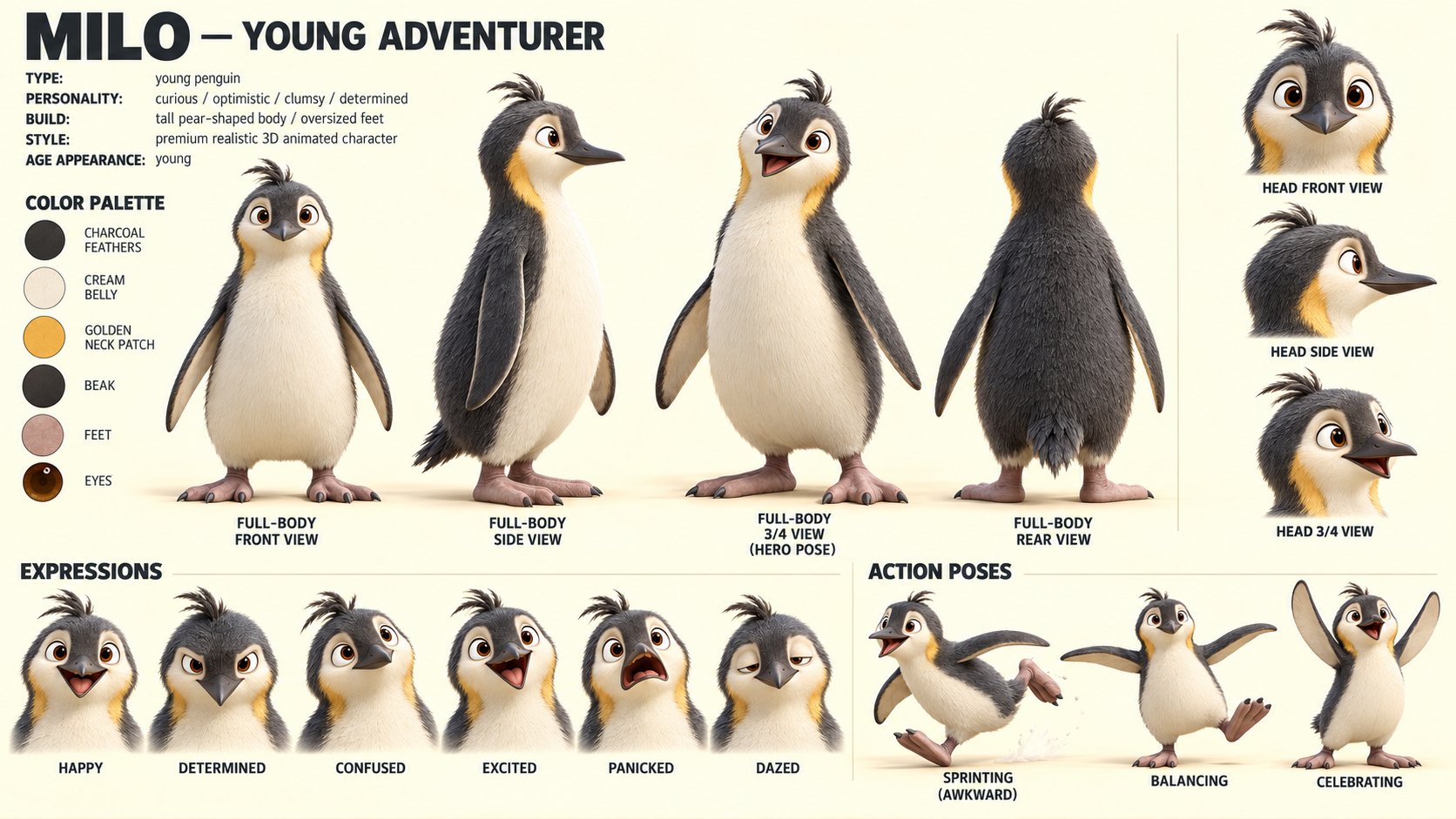
MILO Penguin Apple Sled Comedy (Character Sheet → Seedance 2.5 Workflow)
A two-step workflow: create a premium 3D character reference sheet for an original young penguin named MILO, then hand it to Seedance 2.5 with a 30-second, second-by-second adventure-comedy prompt — Milo drags a bark slab, loads a giant apple, sleds downhill into a leaf pile and finds the apple won't fit through his door. Shared by @HeyAbhishek (prompts written with Claude Opus 5.5).
演示视频
查看案例工作流
按顺序做完这 2 步。复制每一步的提示词,生成后再把结果当作下一步的参考。
- 1
MILO character sheet
图像Create a premium 3D animated character reference sheet for MILO on a clean white or very light bluish off-white studio background, designed like an official high-end feature-film model sheet. Show the exact same original young penguin consistently across full-body front, side, 3/4 hero and rear views, plus head front, side and 3/4 views. Include a compact expression strip with happy, determined, confused, excited, panicked and dazed faces, and three small action poses showing awkward running, balancing with both flippers extended and celebrating with both flippers raised. Add a simple title block and small color palette. Milo has a tall slightly pear-shaped body, soft charcoal-grey feathers over the head, back and outer flippers, a large creamy-white belly, two subtle muted golden-yellow patches along the upper sides of his neck, a small asymmetrical three-feather tuft, warm dark-brown eyes, a narrow slightly curved charcoal-black beak, long thin flippers, slightly visible legs and oversized pinkish-grey webbed feet. Keep his face friendly, innocent and highly expressive, with detailed soft feather texture and natural feather breakup around the chest, neck and flipper edges. Render in premium realistic 3D CGI animated-feature quality with detailed feathers, realistic materials, natural eye reflections, clean cinematic studio lighting and soft contact shadows. No clothing, accessories, shoes, logos, props, environment or additional characters. Maintain the exact same eyes, beak, tuft, golden neck markings, body proportions, flipper length, feather colors and oversized feet in every view. Milo must remain completely original and not resemble any recognizable animated penguin character.
这一步的结果
- 2
Seedance 2.5 video
视频Create an exactly 30-second 3D animated adventure-comedy in 16:9 horizontal format. Use the attached Milo character sheet as the exact visual reference for Milo. Maintain his identical face, brown eyes, three-feather head tuft, charcoal-grey feathers, cream belly, muted golden neck patches, narrow curved dark beak, long thin flippers, tall pear-shaped proportions, oversized pinkish-grey webbed feet and overall silhouette throughout the entire video. The reference defines Milo’s appearance only. The story takes place in one continuous sunny autumn forest-edge clearing. An old wild apple tree grows near the upper part of a broad gently sloping grassy hill. One enormous ripe glossy red apple is already lying naturally on the ground beneath the tree before Milo arrives. The apple is approximately the same height as Milo’s torso and head combined. It is far too heavy for him to lift but round enough that he can roll it by pushing. Several meters away lies exactly one naturally detached broad curved slab of tree bark. The bark is approximately twice Milo’s body length, shallowly concave like a natural tray, thick and rigid enough to keep its shape, and wide enough to support the giant apple with Milo sitting behind it. The bark was already detached before the story begins, and Milo never tears it from a tree. A clear grassy trail leads gently downhill from the apple tree. Near the bottom of the hill is one deep pile of loose dry orange and golden autumn leaves positioned directly across the trail. Immediately beyond and slightly beside that leaf pile is Milo’s small round forest shelter entrance built naturally into an earth bank. The entrance is visibly smaller than the giant apple. Keep the apple tree uphill and the shelter downhill for the entire video. Use a premium photorealistic 3D CGI animated feature-film aesthetic with highly detailed soft penguin feathers, realistic bark, glossy apple skin, dry autumn leaves, lush vegetation, expressive character animation, cinematic warm daylight, vibrant natural colors and exaggerated physical-comedy timing. Maintain realistic gravity, friction, momentum, weight, collisions and object support underneath the stylized animation. Use warm sunny autumn daylight throughout with natural cinematic depth of field. There is no dialogue, no text, no subtitles, no logos, no HUD and no additional characters. From 0:00 to 0:02, open with a wide low tracking shot. Milo suddenly bursts through a patch of low autumn plants and runs into the sunny clearing. His oversized webbed feet rapidly slap against the grass, his long flippers swing beside him and his three-feather tuft bounces slightly. Milo suddenly stops when he sees the enormous glossy red apple beneath the old tree. Warm sunlight reflects from its surface. Milo’s eyes widen, his beak opens slightly and his expression immediately becomes excited. From 0:02 to 0:04, move into a medium frontal shot beside the apple. Milo inspects the enormous fruit, then crouches beside its lowest accessible side. He slides both long flippers underneath it as far as physically possible, bends his knees and tries to lift. The apple does not move. Milo strains harder while his oversized webbed feet begin slipping slightly backward through the grass, but the apple remains fully supported by the ground. From 0:04 to 0:06, use a wide side shot. Milo makes one final enormous lifting effort. His flippers lose their grip against the smooth apple and he falls backward onto the grass. The apple stays completely stationary. Milo lies dazed for a brief moment, raises his head, looks at the apple and then scans the clearing. His eyes stop on the broad curved piece of detached bark lying nearby. He looks at the bark, then at the apple, then back at the bark. His expression changes as he gets an idea. From 0:06 to 0:08, use a wide side tracking shot that clearly shows Milo’s full body, both webbed feet and the entire bark slab at the same time. Milo quickly runs to one narrow end of the bark and remains completely standing on the grass. He does not sit, stand, kneel or ride on the bark. Milo faces the bark, bends forward and grips the narrow end using both long flippers. Both oversized webbed feet stay firmly on the ground. Milo begins walking backward toward the apple, stepping backward with one foot and then the other. His feet press against the grass and provide the traction that moves his body backward. Because both flippers are gripping the bark, his backward movement pulls the bark across the ground toward him. Most of the bark remains continuously supported by and in contact with the grass. The bark never moves underneath Milo and Milo’s body never rests on it. He drags it all the way to the giant apple and releases it. From 0:08 to 0:11, use one clear wide side shot showing Milo, the complete apple and the entire bark slab. Milo positions the bark flat on the grass immediately downhill from the apple with its shallow concave surface facing upward. One end lies close to the fruit. Milo walks around to the uphill side of the apple, places both flippers against it and pushes. His webbed feet remain firmly planted on the ground. The apple slowly rotates forward, first one quarter turn and then another, until it rolls directly onto the center of the curved bark slab. Milo immediately stops pushing. The apple settles naturally into the shallow concave center while the bark remains fully supported by the ground. From 0:11 to 0:13.5, show a wide lateral view. Milo walks behind the loaded bark sled and places both long flippers firmly against its rear edge while both feet remain completely on the grass. He leans his pear-shaped body forward and pushes. The bark begins scraping slowly across the nearly flat ground. His feet visibly push backward against the grass with every step. Milo remains on the ground and does not ride the bark yet. The apple remains nested in the center and moves together with the bark as one loaded sled. From 0:13.5 to 0:15.5, use a wide side shot clearly showing the ground transitioning from almost flat grass into a gentle downhill trail. Milo continues pushing from behind. The front half of the loaded bark reaches the downward slope. As more of the sled moves onto the incline, gravity begins pulling it forward. Milo notices that it is becoming easier to push. The bark gradually starts moving slightly faster than Milo’s walking pace. Milo removes his flippers from the rear edge and begins running directly behind it. From 0:15.5 to 0:18, use a dynamic side tracking shot. The loaded bark continues sliding downhill at a moderate speed because of gravity. Milo runs behind it using his oversized webbed feet. He catches up while the sled is still moving slowly enough to board safely. Milo reaches forward and places both flippers over the rear side edges of the bark. He takes two quick running steps, places one webbed foot onto the rear portion of the bark, then the second foot, and immediately lowers his body. Milo sits securely behind the giant apple and grips the bark edges with both flippers. This is the first time in the entire video that Milo sits or rides on the bark. From 0:18 to 0:21, use a wide cinematic tracking shot moving alongside the trail. The loaded bark sled continues sliding naturally down the gentle hill. Dry leaves scatter slightly underneath the front and side edges. The trail remains completely clear. The bark stays continuously in contact with the ground. The apple remains seated securely in the shallow concave center and does not roll independently. Milo sits directly behind it. At first he looks nervous and grips the bark tightly. After a moment, he realizes the ride is stable. His expression slowly changes from concern to excitement and a delighted smile appears. From 0:21 to 0:23.5, move into a closer side tracking shot. The downhill trail becomes slightly steeper but remains smooth and safe, causing gravity to moderately increase the sled’s speed. Milo continues gripping the bark edges. His charcoal-grey feathers and three-feather tuft move gently in the rushing air. He looks forward and realizes everything appears under control. His confidence grows. Milo straightens his upper body slightly while remaining securely seated, pushes his chest forward and smiles proudly as though the entire ride was planned. From 0:23.5 to 0:25.5, use a front-facing tracking shot moving backward downhill. Milo continues riding proudly behind the giant apple. He looks past the fruit toward the bottom of the hill. Camera pulls slightly wider and reveals the enormous deep pile of orange and golden autumn leaves directly across the trail. Beyond and slightly beside the pile is Milo’s small shelter entrance. Milo initially smiles when he sees home, but then notices how quickly the leaf pile is approaching. His expression changes immediately and he grips both sides of the bark more tightly. From 0:25.5 to 0:27, use one uninterrupted wide side-profile shot. The loaded bark sled enters the deep pile of loose dry autumn leaves. The leaves create strong resistance and friction against the bark, causing the sled to rapidly but smoothly lose speed. A large soft burst of orange and golden leaves sprays outward. The bark remains flat against the ground and never flips. The giant apple stays inside the shallow center and does not launch forward. Milo naturally leans forward because of the deceleration but remains seated safely behind the apple. The sled comes to a complete stop inside the soft leaf pile. Nothing breaks. From 0:27 to 0:28.5, use a medium shot beside the leaf pile. Milo climbs carefully off the stopped bark sled and steps onto the grass. He looks at the giant apple, then turns toward his nearby shelter entrance. His proud smile returns. Milo positions himself behind the apple, places both flippers against it and pushes. The apple rolls slowly off the bark with one controlled rotation and then another. Milo continues walking behind it and pushing it across the short flat patch of ground toward the shelter. From 0:28.5 to 0:30, finish with a static frontal comedy shot facing the shelter entrance. The enormous red apple rolls directly toward the small round doorway. Its diameter is clearly larger than the opening. The curved sides of the apple contact the earth around both sides of the entrance and it stops with a low soft thud. Milo continues pushing for one brief moment but nothing moves. He stops, looks at the shelter entrance, looks at the enormous apple, looks back at the entrance, then slowly looks at the apple again. After one small silent beat, Milo calmly walks around the side of the fruit, sits comfortably on the grass, leans toward the apple and takes one enormous satisfied bite. His eyes close happily and he smiles. Cut to black. Maintain strict Milo consistency throughout all 30 seconds. Never alter his facial structure, brown eyes, three-feather tuft, charcoal-grey feathers, cream belly, muted golden neck patches, dark curved beak, long thin flippers, oversized pinkish-grey webbed feet, pear-shaped body or overall silhouette. There is exactly one giant red apple. It begins resting on the ground beneath the apple tree and remains the exact same fruit throughout the entire video. It never falls from the tree, teleports, duplicates or changes size. There is exactly one curved bark slab. It begins lying naturally on the grass and Milo physically moves it. The bark never moves by itself before Milo pushes it onto the visible downhill slope. It never floats, flies, flips, changes size, changes shape or behaves like fabric. Before 0:15.5, Milo must never sit, stand, kneel, balance or ride on the bark. During the 0:06 to 0:08 dragging action, Milo remains entirely on the grass. Both webbed feet must remain clearly visible on the ground while he walks backward and pulls the bark using both flippers. Never depict Milo sitting on the same bark that he is trying to drag. During the apple-loading and pushing sequence, Milo also remains entirely on the ground. Milo boards the bark for the first time only from 0:15.5 onward after gravity has already started moving the loaded sled downhill. When the apple is on the bark, its full weight remains physically supported by the concave bark surface. The apple never hovers or balances on invisible support. During the downhill ride, the apple stays in direct contact with the bark and does not independently roll ahead or backward. The loaded sled moves slowly across flat ground only while Milo physically pushes it. Continued motion and acceleration occur only once the sled reaches the visible downhill slope and gravity acts on it. The leaf pile is already present before Milo reaches it and contains only loose dry leaves. There are no hidden rocks, logs or hard objects inside. The increasing friction and resistance of the leaves gradually stop the sled. Milo does not fly out, the bark does not flip and the apple does not launch forward. The shelter entrance remains exactly the same size throughout the video and the apple remains exactly the same size. The ending works only because the apple was already wider than the doorway. The doorway never shrinks and the apple never grows. Maintain one continuous uphill-to-downhill geography. The apple tree remains uphill and the shelter remains downhill. Do not mirror or reverse the environment between shots. Once Milo passes a location, it remains geographically behind him. No teleportation, object duplication, object regeneration, invisible supports, spontaneous acceleration, unexplained movement, additional animals or humans. Use readable cinematic framing throughout. Use wide lateral views whenever physical cause and effect matters. During the bark-dragging sequence, keep Milo’s full body, both webbed feet and the entire bark visible at the same time. During the apple-loading action, clearly show the apple physically rolling onto the bark. During the loaded-sled push, clearly show Milo behind the bark with both feet on the ground. Clearly reveal the terrain becoming downhill before the sled begins moving independently. During boarding, show Milo running behind the sled and physically stepping onto it without hiding the transition. Keep the downhill direction consistent and never use camera rotation to fake sled movement. Use a playful adventurous orchestral score throughout. Include rapid webbed-foot footsteps during Milo’s opening run, natural autumn forest ambience, soft wind through leaves, comedic effort sounds while he tries lifting the apple, a soft thump when he falls backward, realistic bark scraping over grass as he drags it, clear webbed footsteps during the dragging action, a low rolling sound as the apple moves onto the bark, heavier scraping as he pushes the loaded sled and gradually more adventurous music when the sled reaches the slope. Add rhythmic dry-leaf and bark-sliding sounds during the downhill ride, light wind rush as the speed increases and a triumphant musical feeling as Milo becomes confident. When the leaf pile appears, shift briefly into playful tension. Use a large soft rush and poof as the sled enters the leaves, followed by falling and settling leaf sounds. Add soft apple-rolling sounds near the shelter, a low thud when the apple contacts the doorway, a tiny pushing effort sound, then brief silence as Milo realizes the problem. Finish with one crisp apple bite and one tiny satisfied orchestral note before cutting to black.
在下方工作台改最后一步,再复制。
参考图
这一步的结果
从示例开始
点一张示例图,整套设置立即套用,再改成你自己的。
改成你的
只展示值得改的部分,提示词会实时更新。
你的提示词
Create an exactly 30-second 3D animated adventure-comedy in 16:9 horizontal format. Use the attached Milo character sheet as the exact visual reference for Milo. Maintain his identical face, brown eyes, three-feather head tuft, charcoal-grey feathers, cream belly, muted golden neck patches, narrow curved dark beak, long thin flippers, tall pear-shaped proportions, oversized pinkish-grey webbed feet and overall silhouette throughout the entire video. The reference defines Milo’s appearance only.

The story takes place in one continuous sunny autumn forest-edge clearing. An old wild apple tree grows near the upper part of a broad gently sloping grassy hill. One enormous ripe glossy red apple is already lying naturally on the ground beneath the tree before Milo arrives. The apple is approximately the same height as Milo’s torso and head combined. It is far too heavy for him to lift but round enough that he can roll it by pushing. Several meters away lies exactly one naturally detached broad curved slab of tree bark. The bark is approximately twice Milo’s body length, shallowly concave like a natural tray, thick and rigid enough to keep its shape, and wide enough to support the giant apple with Milo sitting behind it. The bark was already detached before the story begins, and Milo never tears it from a tree. A clear grassy trail leads gently downhill from the apple tree. Near the bottom of the hill is one deep pile of loose dry orange and golden autumn leaves positioned directly across the trail. Immediately beyond and slightly beside that leaf pile is Milo’s small round forest shelter entrance built naturally into an earth bank. The entrance is visibly smaller than the giant apple. Keep the apple tree uphill and the shelter downhill for the entire video.

Use a premium photorealistic 3D CGI animated feature-film aesthetic with highly detailed soft penguin feathers, realistic bark, glossy apple skin, dry autumn leaves, lush vegetation, expressive character animation, cinematic warm daylight, vibrant natural colors and exaggerated physical-comedy timing. Maintain realistic gravity, friction, momentum, weight, collisions and object support underneath the stylized animation. Use warm sunny autumn daylight throughout with natural cinematic depth of field. There is no dialogue, no text, no subtitles, no logos, no HUD and no additional characters.

From 0:00 to 0:02, open with a wide low tracking shot. Milo suddenly bursts through a patch of low autumn plants and runs into the sunny clearing. His oversized webbed feet rapidly slap against the grass, his long flippers swing beside him and his three-feather tuft bounces slightly. Milo suddenly stops when he sees the enormous glossy red apple beneath the old tree. Warm sunlight reflects from its surface. Milo’s eyes widen, his beak opens slightly and his expression immediately becomes excited.

From 0:02 to 0:04, move into a medium frontal shot beside the apple. Milo inspects the enormous fruit, then crouches beside its lowest accessible side. He slides both long flippers underneath it as far as physically possible, bends his knees and tries to lift. The apple does not move. Milo strains harder while his oversized webbed feet begin slipping slightly backward through the grass, but the apple remains fully supported by the ground.

From 0:04 to 0:06, use a wide side shot. Milo makes one final enormous lifting effort. His flippers lose their grip against the smooth apple and he falls backward onto the grass. The apple stays completely stationary. Milo lies dazed for a brief moment, raises his head, looks at the apple and then scans the clearing. His eyes stop on the broad curved piece of detached bark lying nearby. He looks at the bark, then at the apple, then back at the bark. His expression changes as he gets an idea.

From 0:06 to 0:08, use a wide side tracking shot that clearly shows Milo’s full body, both webbed feet and the entire bark slab at the same time. Milo quickly runs to one narrow end of the bark and remains completely standing on the grass. He does not sit, stand, kneel or ride on the bark. Milo faces the bark, bends forward and grips the narrow end using both long flippers. Both oversized webbed feet stay firmly on the ground. Milo begins walking backward toward the apple, stepping backward with one foot and then the other. His feet press against the grass and provide the traction that moves his body backward. Because both flippers are gripping the bark, his backward movement pulls the bark across the ground toward him. Most of the bark remains continuously supported by and in contact with the grass. The bark never moves underneath Milo and Milo’s body never rests on it. He drags it all the way to the giant apple and releases it.

From 0:08 to 0:11, use one clear wide side shot showing Milo, the complete apple and the entire bark slab. Milo positions the bark flat on the grass immediately downhill from the apple with its shallow concave surface facing upward. One end lies close to the fruit. Milo walks around to the uphill side of the apple, places both flippers against it and pushes. His webbed feet remain firmly planted on the ground. The apple slowly rotates forward, first one quarter turn and then another, until it rolls directly onto the center of the curved bark slab. Milo immediately stops pushing. The apple settles naturally into the shallow concave center while the bark remains fully supported by the ground.

From 0:11 to 0:13.5, show a wide lateral view. Milo walks behind the loaded bark sled and places both long flippers firmly against its rear edge while both feet remain completely on the grass. He leans his pear-shaped body forward and pushes. The bark begins scraping slowly across the nearly flat ground. His feet visibly push backward against the grass with every step. Milo remains on the ground and does not ride the bark yet. The apple remains nested in the center and moves together with the bark as one loaded sled.

From 0:13.5 to 0:15.5, use a wide side shot clearly showing the ground transitioning from almost flat grass into a gentle downhill trail. Milo continues pushing from behind. The front half of the loaded bark reaches the downward slope. As more of the sled moves onto the incline, gravity begins pulling it forward. Milo notices that it is becoming easier to push. The bark gradually starts moving slightly faster than Milo’s walking pace. Milo removes his flippers from the rear edge and begins running directly behind it.

From 0:15.5 to 0:18, use a dynamic side tracking shot. The loaded bark continues sliding downhill at a moderate speed because of gravity. Milo runs behind it using his oversized webbed feet. He catches up while the sled is still moving slowly enough to board safely. Milo reaches forward and places both flippers over the rear side edges of the bark. He takes two quick running steps, places one webbed foot onto the rear portion of the bark, then the second foot, and immediately lowers his body. Milo sits securely behind the giant apple and grips the bark edges with both flippers. This is the first time in the entire video that Milo sits or rides on the bark.

From 0:18 to 0:21, use a wide cinematic tracking shot moving alongside the trail. The loaded bark sled continues sliding naturally down the gentle hill. Dry leaves scatter slightly underneath the front and side edges. The trail remains completely clear. The bark stays continuously in contact with the ground. The apple remains seated securely in the shallow concave center and does not roll independently. Milo sits directly behind it. At first he looks nervous and grips the bark tightly. After a moment, he realizes the ride is stable. His expression slowly changes from concern to excitement and a delighted smile appears.

From 0:21 to 0:23.5, move into a closer side tracking shot. The downhill trail becomes slightly steeper but remains smooth and safe, causing gravity to moderately increase the sled’s speed. Milo continues gripping the bark edges. His charcoal-grey feathers and three-feather tuft move gently in the rushing air. He looks forward and realizes everything appears under control. His confidence grows. Milo straightens his upper body slightly while remaining securely seated, pushes his chest forward and smiles proudly as though the entire ride was planned.

From 0:23.5 to 0:25.5, use a front-facing tracking shot moving backward downhill. Milo continues riding proudly behind the giant apple. He looks past the fruit toward the bottom of the hill. Camera pulls slightly wider and reveals the enormous deep pile of orange and golden autumn leaves directly across the trail. Beyond and slightly beside the pile is Milo’s small shelter entrance. Milo initially smiles when he sees home, but then notices how quickly the leaf pile is approaching. His expression changes immediately and he grips both sides of the bark more tightly.

From 0:25.5 to 0:27, use one uninterrupted wide side-profile shot. The loaded bark sled enters the deep pile of loose dry autumn leaves. The leaves create strong resistance and friction against the bark, causing the sled to rapidly but smoothly lose speed. A large soft burst of orange and golden leaves sprays outward. The bark remains flat against the ground and never flips. The giant apple stays inside the shallow center and does not launch forward. Milo naturally leans forward because of the deceleration but remains seated safely behind the apple. The sled comes to a complete stop inside the soft leaf pile. Nothing breaks.

From 0:27 to 0:28.5, use a medium shot beside the leaf pile. Milo climbs carefully off the stopped bark sled and steps onto the grass. He looks at the giant apple, then turns toward his nearby shelter entrance. His proud smile returns. Milo positions himself behind the apple, places both flippers against it and pushes. The apple rolls slowly off the bark with one controlled rotation and then another. Milo continues walking behind it and pushing it across the short flat patch of ground toward the shelter.

From 0:28.5 to 0:30, finish with a static frontal comedy shot facing the shelter entrance. The enormous red apple rolls directly toward the small round doorway. Its diameter is clearly larger than the opening. The curved sides of the apple contact the earth around both sides of the entrance and it stops with a low soft thud. Milo continues pushing for one brief moment but nothing moves. He stops, looks at the shelter entrance, looks at the enormous apple, looks back at the entrance, then slowly looks at the apple again. After one small silent beat, Milo calmly walks around the side of the fruit, sits comfortably on the grass, leans toward the apple and takes one enormous satisfied bite. His eyes close happily and he smiles. Cut to black.

Maintain strict Milo consistency throughout all 30 seconds. Never alter his facial structure, brown eyes, three-feather tuft, charcoal-grey feathers, cream belly, muted golden neck patches, dark curved beak, long thin flippers, oversized pinkish-grey webbed feet, pear-shaped body or overall silhouette.

There is exactly one giant red apple. It begins resting on the ground beneath the apple tree and remains the exact same fruit throughout the entire video. It never falls from the tree, teleports, duplicates or changes size. There is exactly one curved bark slab. It begins lying naturally on the grass and Milo physically moves it. The bark never moves by itself before Milo pushes it onto the visible downhill slope. It never floats, flies, flips, changes size, changes shape or behaves like fabric.

Before 0:15.5, Milo must never sit, stand, kneel, balance or ride on the bark. During the 0:06 to 0:08 dragging action, Milo remains entirely on the grass. Both webbed feet must remain clearly visible on the ground while he walks backward and pulls the bark using both flippers. Never depict Milo sitting on the same bark that he is trying to drag. During the apple-loading and pushing sequence, Milo also remains entirely on the ground. Milo boards the bark for the first time only from 0:15.5 onward after gravity has already started moving the loaded sled downhill.

When the apple is on the bark, its full weight remains physically supported by the concave bark surface. The apple never hovers or balances on invisible support. During the downhill ride, the apple stays in direct contact with the bark and does not independently roll ahead or backward. The loaded sled moves slowly across flat ground only while Milo physically pushes it. Continued motion and acceleration occur only once the sled reaches the visible downhill slope and gravity acts on it.

The leaf pile is already present before Milo reaches it and contains only loose dry leaves. There are no hidden rocks, logs or hard objects inside. The increasing friction and resistance of the leaves gradually stop the sled. Milo does not fly out, the bark does not flip and the apple does not launch forward.

The shelter entrance remains exactly the same size throughout the video and the apple remains exactly the same size. The ending works only because the apple was already wider than the doorway. The doorway never shrinks and the apple never grows.

Maintain one continuous uphill-to-downhill geography. The apple tree remains uphill and the shelter remains downhill. Do not mirror or reverse the environment between shots. Once Milo passes a location, it remains geographically behind him. No teleportation, object duplication, object regeneration, invisible supports, spontaneous acceleration, unexplained movement, additional animals or humans.

Use readable cinematic framing throughout. Use wide lateral views whenever physical cause and effect matters. During the bark-dragging sequence, keep Milo’s full body, both webbed feet and the entire bark visible at the same time. During the apple-loading action, clearly show the apple physically rolling onto the bark. During the loaded-sled push, clearly show Milo behind the bark with both feet on the ground. Clearly reveal the terrain becoming downhill before the sled begins moving independently. During boarding, show Milo running behind the sled and physically stepping onto it without hiding the transition. Keep the downhill direction consistent and never use camera rotation to fake sled movement.

Use a playful adventurous orchestral score throughout. Include rapid webbed-foot footsteps during Milo’s opening run, natural autumn forest ambience, soft wind through leaves, comedic effort sounds while he tries lifting the apple, a soft thump when he falls backward, realistic bark scraping over grass as he drags it, clear webbed footsteps during the dragging action, a low rolling sound as the apple moves onto the bark, heavier scraping as he pushes the loaded sled and gradually more adventurous music when the sled reaches the slope. Add rhythmic dry-leaf and bark-sliding sounds during the downhill ride, light wind rush as the speed increases and a triumphant musical feeling as Milo becomes confident. When the leaf pile appears, shift briefly into playful tension. Use a large soft rush and poof as the sled enters the leaves, followed by falling and settling leaf sounds. Add soft apple-rolling sounds near the shelter, a low thud when the apple contacts the doorway, a tiny pushing effort sound, then brief silence as Milo realizes the problem. Finish with one crisp apple bite and one tiny satisfied orchestral note before cutting to black.
点击高亮部分即可直接修改。
适用场景
Use when you want a consistent original 3D animal character in a physics-driven slapstick short and need the reference-sheet step that locks identity.
怎样效果最好
- Run the character-sheet prompt first and attach that image as the Seedance reference.
- Rename the character as one value so every mention stays consistent.
- Keep the continuity rules (one apple, one bark slab, fixed geography); they stop Seedance from teleporting or duplicating props.
避坑提醒
- Very long prompts can drop late beats — check the ending and regenerate if the doorway gag is skipped.
- Seedance may let Milo ride the bark too early; the prompt forbids it before 0:15.5, so restate that line if needed.
相关模板
- Manga-Panel Music Video Edit from Two Clips (Claude Opus 5.5)Use when you have two AI-generated (or your own) action clips and a music file and want an AMV / anime-opening style edit built by Claude with code, no editing software.
- Restaurant Kitchen Martial-Arts Fight Scene (Seedance 2.5, 10s Beat List)Use when you want a short, cinematic action beat with clear second-by-second choreography and a richly dressed real-world location.
- Character Goodnight Bedroom Visual (ChatGPT Image, Japanese Prompt)Use when you want a soft, personal bedtime illustration of your own original character that reflects their personality down to the pajamas and bedroom decor.
- Character Fashion Magazine Cover (ChatGPT Image, Japanese Prompt)Use when you have an original character and want a polished, magazine-style key visual that shows them in a fresh, modern outfit.
- Gunslinger vs Giant Slow-Mo Sandevistan Shot List (Seedance 2.5)Use when you want a stylised action beat with a slow-motion afterimage ('Sandevistan') effect, a rewind and a full-speed replay, all inside one Seedance generation.
- AI Coding Session Observability Dashboard + Harness Tuning (Claude Code / Codex)Use when you run Claude Code or Codex daily and want to see where your tokens, failures and time actually go before tuning your agent setup.
来源与归属
- 示例案例作者
- Abhishek